What is the essence of Clean Language?
Clean Language offers a broad range of tools and models.
The essence, though, is the attitude with which you shape your interactions with others:
- You are continuously aware of the distinction between your experience and that of the other person.
- You explore someone else’s perspective without judgement and without mixing in your own.
- You use the language (Clean Language) that fits that posture.
- And sometimes you make a conscious choice to depart from it.
Why would you?
- Clean Language helps you improve communication with your customers, colleagues, clients and patients.
- Clean Language reduces friction and miscommunication.
- Clean Language helps you work less hard as a coach, facilitator or mentor.
- Clean Language keeps ownership where it belongs.
- Clean Language supports lasting change.
A language made up entirely of questions
In addition to the essence described above, Clean Language is a language made up entirely of questions! Questions that have, as far as possible, been scrubbed of your own assumptions and frame of reference. So when you use them, you give the other person plenty of room and treat their experience with deep respect. Below you’ll find the 12 basic Clean Language questions. You use them by filling in the other person’s (key) words on the dotted line. The Clean Language questions can be grouped by the kind of information they typically reveal.

By learning Clean Language I’ve tenfolded my capacity to really hear other people.
Questions for identifying characteristics
- And what kind of […] is that […]?
- And is there anything else about that […]?
- And does […] have a size or a shape?
Questions for finding a location
- And where is […]?
- And whereabouts […]?
Questions for examining sequence
- And then what happens?
- And what happens next?
- And what happens just before […]?
Question for inviting a metaphor
- And that […] is like what?
Question for identifying a Desired Outcome
- And what would you like to have happen?
Questions about relationships
- And when [X], what happens to [Y]?
- And is there a relationship between […] and […]?
- And where could […] come from?
Questions for determining necessary conditions
- And what needs to happen for […]?
- And what needs to happen for that?
- And can […]?
Clean Language Principles
At the end of 2024 a group of Clean Language leaders from around the world came together in Portugal. They discussed several topics, among them describing and recording the Clean Language Principles. A few months later that work became reality, and since then the principles have been published on James and Penny’s website: https://cleanlanguage.com/clean-language-principles
Following on from those English-language principles, a small group from the Clean Language Community Netherlands has translated them into Dutch. Below you’ll find the Dutch translation both as plain text and as an image. The English original and the Dutch translation are both published under a Creative Commons licence.
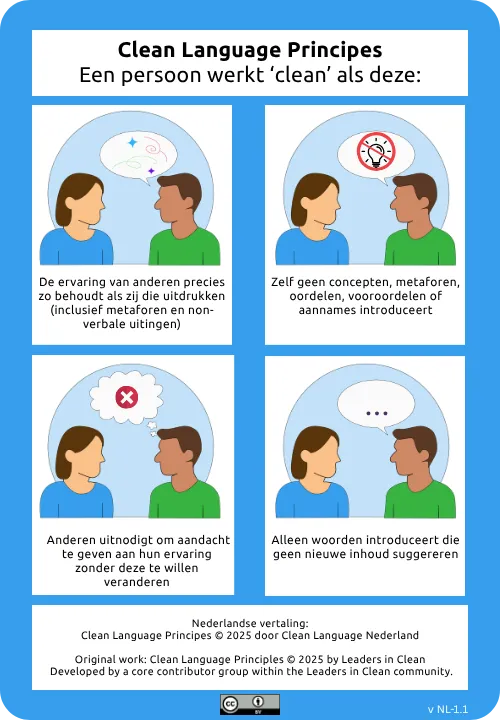
A person works “clean” when they:
- Preserve other people's experience exactly as they express it (including metaphors and non-verbal expressions), and
- Do not introduce their own concepts, metaphors, judgements, prejudices or assumptions, and
- Invite others to give attention to their experience without wanting to change it, and
- Only introduce words that suggest no new content.
Dutch translation: Clean Language Principes © 2025 by Clean Language Nederland
Original work: Clean Language Principles © 2025 by Leaders in Clean Developed by a core contributor group within the Leaders in Clean community.
What else comes with it
Alongside the low-assumption questions and the Clean Language Principles described above, there are a few other important elements worth mentioning:
- Working with metaphor! Metaphors help people come up with different and new solutions, bridge conscious and less-conscious processes, and offer protection when working with painful experiences;
- Outcome-focused work, where you direct attention to what the other person really wants rather than digging deeper into the problem;
- Working with space (Clean Space), where you let the room be your co-facilitator. A modality best compared to (family or organisational) constellations, where the client typically takes the different perspectives themselves.
The methodology also includes supporting models like Clean Set Up — the way to surface expectations at the start of any meeting (or collaboration) — and Clean Feedback, the way to separate observations from your interpretation of them. And there’s plenty more, including a number of very pragmatic tools for Better Conversations at work.
Applications
Clean Language — literally “clean speech” — has its roots in psychotherapy. Its application in coaching is therefore an obvious step. The real strength of Clean Language, though, shows in the breadth of applications and domains where it’s effective. Specialists in team development, organisational consulting, coaching, agile ways of working (including scrum), education and bodywork (haptonomy and shiatsu) all draw on Clean Language. You’ll find several examples on the Community page.
The founder: David Grove
We’d like to acknowledge a few founders and thought leaders of the methodology here. As mentioned, Clean Language is originally a therapeutic methodology. It was developed by David Grove, a New Zealand psychotherapist, in his work with often severely traumatised patients. David was half Māori, and until the Māori had to negotiate with the British over the division of New Zealand, they had no written language. Perhaps that’s where his sensitivity to language came from. David Grove developed a number of beautiful processes both within this methodology and adjacent to it.
David was a highly intuitive practitioner, and Penny Tompkins & James Lawley mapped his way of working and brought more structure to it. They introduced the term Symbolic Modelling. Symbolic Modelling is about working with and developing the metaphorical representation of someone’s experience.
Caitlin Walker applied the Clean Language questions and systemic principles in her work with groups. She helps group members become curious about each other and so create a learning system. She named this approach Systemic Modelling.